Gin Rummy Classic
- 4.7
- Rating
- 100.00K
- Installs
- Free
- Price
 Analysis by App-foxy
Gin Rummy Classic is the kind of card game I can open for a short break without needing to learn a complicated system first. Its appeal comes from the familiar rules of gin rummy: build useful groups, improve your hand, watch what the other player takes, and decide when your cards are strong enough to end the round. After spending time with it, my main impression is simple: this is a focused choice for people who want a traditional card game on a phone, not a large collection of distractions around it.
That focus is both its biggest strength and its main limitation. The game is easy to understand, quick to return to, and suitable for quiet solo sessions. At the same time, players looking for elaborate progression, a broad multiplayer community, or a card-game hub with many different modes may find the experience too narrow. I would recommend it most to someone who already enjoys gin rummy or wants a straightforward way to practice the basic rhythm of the game.
Why the classic format still works on a phone
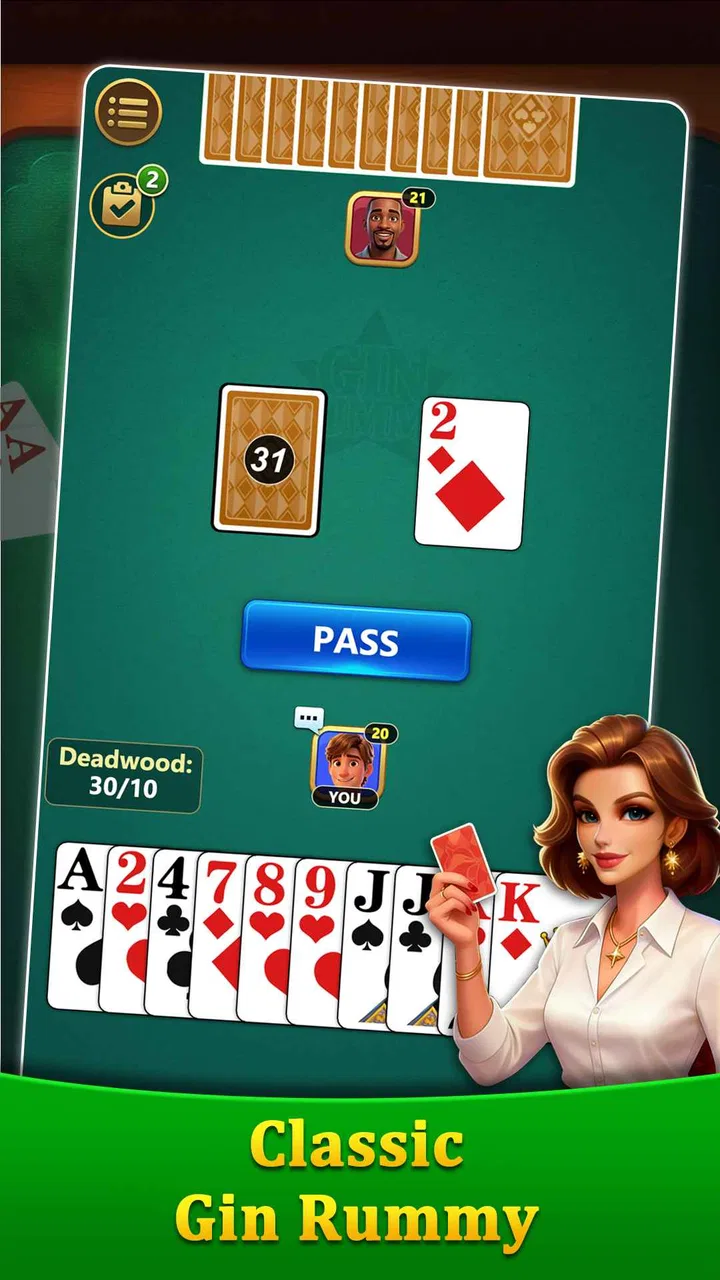
The central pleasure of gin rummy is making decisions with incomplete information. Every card you draw changes the value of the hand, while every discarded card gives the opponent a clue about what you may be collecting. That creates more tension than the simple act of matching cards. I found myself thinking not only about the hand I wanted, but also about what my opponent might be trying to complete.
You May Also Like

 Pandora - Music & Podcasts
Pandora’s Music Is Easy to Start, but Harder to Recover
Pandora’s strength is its low-effort path from a seed to a station. Its weak spot is how much confidence it asks you to place in connection, setup, and quiet recovery.

 AccuWeather: Weather Radar
AccuWeather Review: A Quick, Clear Forecast for Everyday Decisions
For everyday plans, the best forecast is the one you can understand quickly. AccuWeather makes rain timing, radar, and local conditions easy to act on, with a few trade-offs.

 Hill Climb Racing
Why Hill Climb Racing Still Turns Crashes Into One More Run
A tiny car, a bumpy hill and one more upgrade: Hill Climb Racing keeps resurfacing because its simple chaos makes every near-miss feel personal.

 AliExpress - Shopping App
AliExpress Makes Global Shopping Feel Personal, but Shoppers Bear the Risk
AliExpress turns a global marketplace into a pocket-sized discovery engine. Its reach is useful, its shopping loop compelling, and its trade-offs easy to miss.

 Lords Mobile: Kingdom Wars
Lords Mobile Is a Kingdom-Building Routine, Not a Quick Match
A case-by-case verdict on the building, battles, device demands, and social commitments that make Lords Mobile rewarding for some players and exhausting for others.

 PDF Scanner app - TapScanner
TapScanner Makes Paperwork Easier to Capture, Check, and Share
TapScanner makes scanning with a phone feel less like a rescue operation and more like a dependable step in getting work done. Its capture tools are useful, though not flawless.
More From Our News Desk
View All News


That makes this release more thoughtful than a purely casual time-killer. A good turn often involves a trade-off: keep a card that might complete a sequence later, or discard it now to reduce deadwood and make the hand easier to manage. The best move is not always the one that looks immediately useful. Sometimes a modest improvement is safer than holding several uncertain possibilities.
The game’s presentation is built around that traditional identity. SATORISYS PLAY has kept the concept recognizable rather than turning it into a themed adventure or a collection of unrelated challenges. For a player who wants to sit down and play gin rummy without navigating a crowded interface, that restraint is welcome.
I also like how naturally the format fits short sessions. A round can become a quick pause between tasks, but the decisions are substantial enough to support a longer sitting. I can imagine playing it while waiting for an appointment, relaxing before bed, or taking a break from a more demanding game. It does not require the commitment that a long strategy title demands, yet it still rewards attention.
Reading the discard pile is more important than chasing perfect cards
One useful habit is to treat the discard pile as information rather than simply as a source of cards. If the opponent repeatedly ignores a certain suit or rank, that can influence what I am comfortable throwing away. It is not proof of their plan, but it helps narrow the possibilities. In a close round, these small observations matter more than trying to create the most attractive combination in my own hand.
I would also avoid holding too many cards that are only valuable in one very specific combination. A hand filled with hopeful possibilities can look promising while quietly accumulating deadwood. When I play more decisively, I usually get better results: keep the strongest route, discard the least flexible card, and reassess after the next draw.
That approach is especially helpful for newcomers. Gin rummy can seem random at first because the draw determines so much, but the player still controls risk. Learning when to abandon a weak plan is one of the first meaningful improvements a beginner can make. The game gives that lesson room to develop because its rules are familiar enough that attention can stay on decision-making.
A useful game for learning patience and probability
I would not describe this as a teaching tool in the formal sense, but it naturally encourages a few transferable habits. Players begin to notice which cards are flexible, how quickly a hand can deteriorate, and why delaying a decision can sometimes be worse than accepting a small loss. Those lessons are easy to miss in a faster, more visually noisy card game.
There is also a mental difference between a lucky draw and a well-managed hand. A fortunate card can rescue a poor position, but it cannot replace good discarding over several turns. When I judge a session, I pay attention to whether I kept my options open without becoming indecisive. That is where the game has more depth than its simple appearance suggests.
For experienced gin rummy players, this familiarity is the point. They do not need a new ruleset or a dramatic reward structure to enjoy the game. For beginners, the same simplicity lowers the barrier to entry. The learning curve is present, but it comes from improving judgment rather than memorizing a large set of special abilities.
Where the experience feels strongest
The strongest part of Gin Rummy Classic is its clarity of purpose. It is a card game first, and the familiar format makes it easy to understand what I should be doing from the opening hand. I do not have to spend time learning a fictional economy, unlocking a complicated deck, or interpreting a long list of effects before the actual play begins.
That makes it a good companion for players who prefer traditional games. If I already know the basics, I can concentrate on tempo and risk. If I am still learning, I can focus on the relationship between draws, melds, discards, and deadwood. The same structure supports both casual and more deliberate play, although the satisfaction will depend on how much I enjoy repeating one core game.
The free price also makes it easy to try without turning the decision into a financial commitment. I would still judge it by whether I enjoy the repeated rounds rather than by the fact that it costs nothing. A free card game is only worthwhile if its central loop remains pleasant after the novelty wears off, and this one has enough decision-making to keep the basic format interesting for the right audience.
Its current version is 1.0.0, which is worth keeping in mind when setting expectations. I approach a first release as a focused starting point rather than assuming it will already have the breadth of a long-established card platform. That does not make it a poor choice; it simply means the appeal is concentrated in the core gin rummy experience.
The meaningful limitation: narrow scope can become repetitive
The same focus that makes the game approachable may eventually make it feel limited. If I want several card games in one app, a large selection of rule variations, or a strong social layer, this is unlikely to be my first choice. Gin rummy depends on repeated rounds with familiar decisions, so players who need constant novelty may lose interest sooner than dedicated fans of the format.
This is also not the ideal pick for someone who dislikes games where luck and judgment interact. Even a careful player can receive an awkward hand or watch an opponent complete a useful combination at the right moment. Skill affects how well I manage those situations, but it does not remove uncertainty. Players who want complete control over every outcome may prefer a puzzle or a deterministic strategy game instead.
Another trade-off is the difference between a short session and a long one. The game works well when I want a compact mental break, but a lengthy session can expose the repetition in its structure. I would play it in rounds rather than expecting an endlessly expanding experience. That mindset makes the simplicity feel intentional instead of incomplete.
For a social player, I would compare it with a multiplayer-focused card app before choosing. A dedicated online alternative may be better if the main goal is competing with friends, joining events, or building a visible record against a large community. Gin Rummy Classic makes more sense when the priority is the card game itself and a low-friction way to return to it.
Who should install it and who should skip it
I think this is a strong fit for traditional card-game fans, casual players who enjoy short strategic sessions, and beginners curious about gin rummy. It is also suitable for people who want a familiar game that can be picked up quickly after a long gap. The age rating is Teen, so families should consider that rating when deciding whether it is appropriate for a younger player.
The game may suit someone who likes quiet concentration more than constant stimulation. I can play a round while taking a break from work and still feel that I made meaningful choices, rather than simply tapping through a sequence. That makes it more satisfying than a purely automatic pastime, especially when I am in the mood to think but not to learn a whole new system.
I would skip it if I were searching for a broad card collection, a highly social competition, or a game with extensive long-term progression. I would also look elsewhere if I wanted a visually spectacular production or a large amount of content outside the central rules. Its value depends on appreciating gin rummy itself; there is no reason to choose it over a broader alternative if the classic format is not what I want.
The public response is encouraging, with an average of 4.8 from around 687 ratings and roughly 46 written reviews. It has passed 10K+ installs, which suggests that the game has already reached a modest group of players without pretending to be a massive platform. I read those figures as a sign of early interest, not as a guarantee that every player will enjoy the same narrow focus.
Small habits that make each session better
My first practical tip is to decide what kind of hand I am building before I become attached to every promising card. If I have two cards that could connect in several ways, they may be worth keeping. If a card only works with one unlikely draw, it can be more sensible to release it and reduce the hand’s risk. This keeps the round moving instead of turning every draw into a reason to postpone a decision.
My second tip is to remember that the opponent’s discard choices are useful even when I cannot complete the same combinations. A card they refuse may be dangerous to offer repeatedly, while a card they take can reveal the kind of sequence or group they value. I do not need to guess their entire hand; I only need to notice enough to avoid helping them carelessly.
My third tip is to change the goal when the hand turns bad. Trying to force a perfect arrangement after several unhelpful draws can leave too much deadwood. Sometimes the better objective is damage control: keep the cards with multiple possible connections, discard isolated values, and prepare to end the round with a manageable total. That shift is subtle, but it is one of the clearest ways to improve beyond beginner play.
A fourth useful habit is to separate a lucky win from a good decision. I may draw exactly what I need and still have played the earlier turns poorly. Conversely, I may lose after making sensible choices because the final cards do not cooperate. Looking at the process instead of only the result helps keep the game enjoyable and makes repeated sessions more instructive.
How it compares with other ways to play cards
Compared with a physical deck, the app is more convenient because the cards, turn flow, and round structure are handled on the device. I can play without finding a partner, clearing a table, or remembering every small step. The physical version still has an advantage for people who enjoy face-to-face conversation and the tactile feel of handling cards, so the digital format is a convenience rather than a complete replacement.
Compared with solitaire, gin rummy offers more uncertainty from another player’s choices. I am not only arranging cards against a fixed challenge; I am also watching what the opponent accepts and rejects. That makes each discard feel more consequential. Solitaire may be better when I want a purely private puzzle, while this game is better when I enjoy indirect competition.
Compared with collectible card games, this release is much easier to approach because the challenge does not depend on assembling a powerful collection or learning many card effects. That simplicity is refreshing, but collectible games provide more variety and customization for players who enjoy building decks. The right choice comes down to whether I want to refine decisions within one classic ruleset or constantly change the tools I use.
Compared with a large card-game suite, Gin Rummy Classic is more specialized. A suite offers variety in exchange for menus, multiple rule systems, and a less concentrated identity. This game is preferable when I know I want gin rummy and would rather reach the table quickly. It is less attractive when I am undecided about which card game I want to play.
My final recommendation
Gin Rummy Classic succeeds because it does not need to disguise a well-designed traditional game as something else. Its strongest qualities are its recognizable rules, compact session length, and the steady decision-making that appears in every draw and discard. I especially appreciate that it gives beginners a clear path toward better play while still leaving experienced players room to think about risk, information, and timing.
The limitations are just as clear. The experience is specialized, and repetition will be part of the bargain. Players seeking a large social network, many card variants, or an elaborate progression system should choose a broader alternative. The Teen rating should also be considered by anyone selecting games for a younger audience.
For me, the verdict is positive but specific: I would recommend it to a friend who wants a focused, free gin rummy game for relaxed strategic sessions. I would not present it as an all-purpose card collection or as a substitute for every way of playing cards. If the classic format is what you came for, SATORISYS PLAY has made a sensible first release that is easy to start and rewarding enough to revisit.
FAQs for Gin Rummy Classic
01What features does Gin Rummy Classic offer?
Gin Rummy Classic provides a seamless card-playing experience with features such as multiple game modes, customizable avatars, and an intuitive user interface. Players can enjoy both online and offline modes, challenge friends or AI opponents, and track their progress with detailed statistics. The app also includes a tutorial for beginners, making it accessible for all skill levels.
02Is Gin Rummy Classic free to download and play?
Yes, Gin Rummy Classic is free to download and play. However, it does offer in-app purchases for additional features, such as ad-free gameplay and premium avatars. While the basic game remains fully functional without purchases, these options can enhance the overall experience for those willing to invest a little more.
03Can I play Gin Rummy Classic offline?
Absolutely! Gin Rummy Classic includes an offline mode, allowing players to enjoy the game without an internet connection. This feature is perfect for users who want to practice their skills or pass the time during travel or in areas with limited connectivity. The AI opponents provide a challenging and engaging experience offline.
04How does the online multiplayer mode work in Gin Rummy Classic?
The online multiplayer mode in Gin Rummy Classic allows you to compete against players from around the world in real-time. You can invite friends to join your game or be matched with random opponents. The app ensures a smooth gameplay experience with minimal lag, and features such as chat and friend lists enhance the social aspect of the game.
05What are the system requirements for Gin Rummy Classic?
Gin Rummy Classic is designed to run on both Android and iOS devices. For Android users, the app requires version 4.1 or higher, while iOS users need version 9.0 or later. The lightweight design ensures that it runs smoothly on most smartphones and tablets, making it accessible to a wide audience without needing high-end hardware.
Pros
- Intuitive interface makes gameplay smooth.
- Multiple difficulty levels for all players.
- Offline mode available for solo play.
- Daily challenges keep the game fresh.
- Customizable themes enhance user experience.
Cons
- Ads can be intrusive during gameplay.
- Limited online multiplayer features.
- In-app purchases for advanced features.
- Occasional app crashes reported by users.
- Lacks a tutorial for new players.

Gin Rummy Classic
Gallery